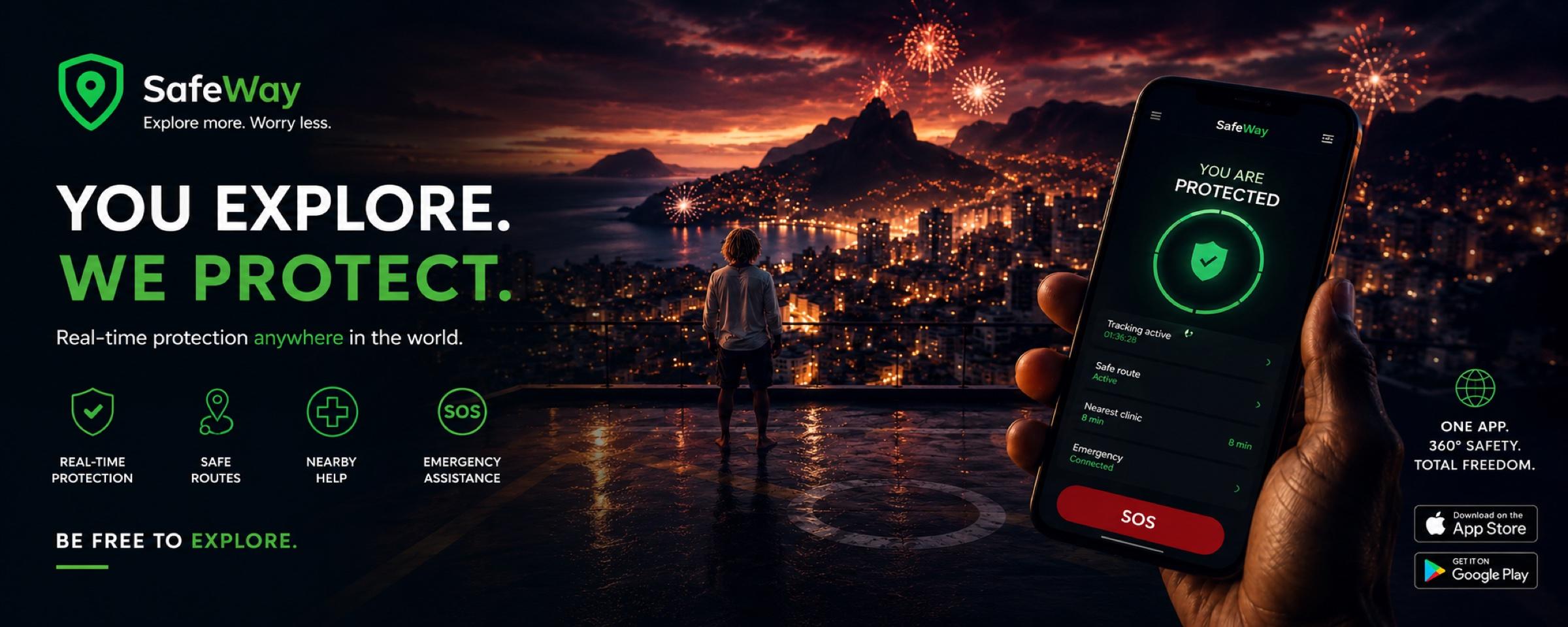
Cinematic AI · Fictional campaign
SafeWay.
Cinematic AI short film and fictional safety-app campaign — Rocinha, Rio, solo travel and freedom.
The pitch
04 chaptersSafeWay started from a real feeling. A few years ago, on a solo trip to Brazil, I kept feeling this paradox: traveling alone is one of the most beautiful experiences in the world, but it comes with vulnerability, uncertainty and fear. Especially as a woman traveling alone. I started imagining an invisible layer of protection following you everywhere — not invasive, not corporate, just a calm, intelligent companion.
The film is a hybrid between cinematic storytelling and futuristic product advertising. It follows a young foreign traveler arriving in Rocinha favela in Rio at blue hour, climbing through steep narrow streets on the back of a moto taxi, then reaching a rooftop overlooking Rio at night with fireworks in the distance. The emotional arc moves from adrenaline to wonder.
Technology should not interrupt life — it should quietly allow people to live more freely.
The world stays grounded in reality — no holograms, no futuristic architecture, no cyberpunk. The 'future' feeling comes only from atmosphere, pacing, camera language, lighting and very subtle interface design. Visual references: Villeneuve atmosphere, Apple cinematic product films, tropical urban realism, high-end advertising cinematography.
At its heart, SafeWay isn't really about technology. It's about this feeling: being free enough to fully experience the beauty of the world. Even in unfamiliar places. Even alone. Even far from home.
The stack
Storytelling & prompting
Video generation
Editing & sound design
Behind the scenes
04 stepsHow I built it scene by scene.
Built like a real film production pipeline. Full visual moodboard first, then the main character generated entirely with AI image generation, then every scene designed image by image with ultra-detailed cinematic prompts.
Each shot animated individually with Higgsfield and Seedance, then assembled and paced in CapCut. Continuity between shots is built by hand — that's where the real work lives.
Hours iterating one scene to land the right motion, the right camera weight, the right emotional read. The fight is never with the AI — it's with continuity.
I'm a software engineer by training, not a filmmaker. This project pushed me well outside my comfort zone — pacing, framing, lighting, atmosphere. And it taught me that AI filmmaking is a new creative language we're all discovering in real time.